


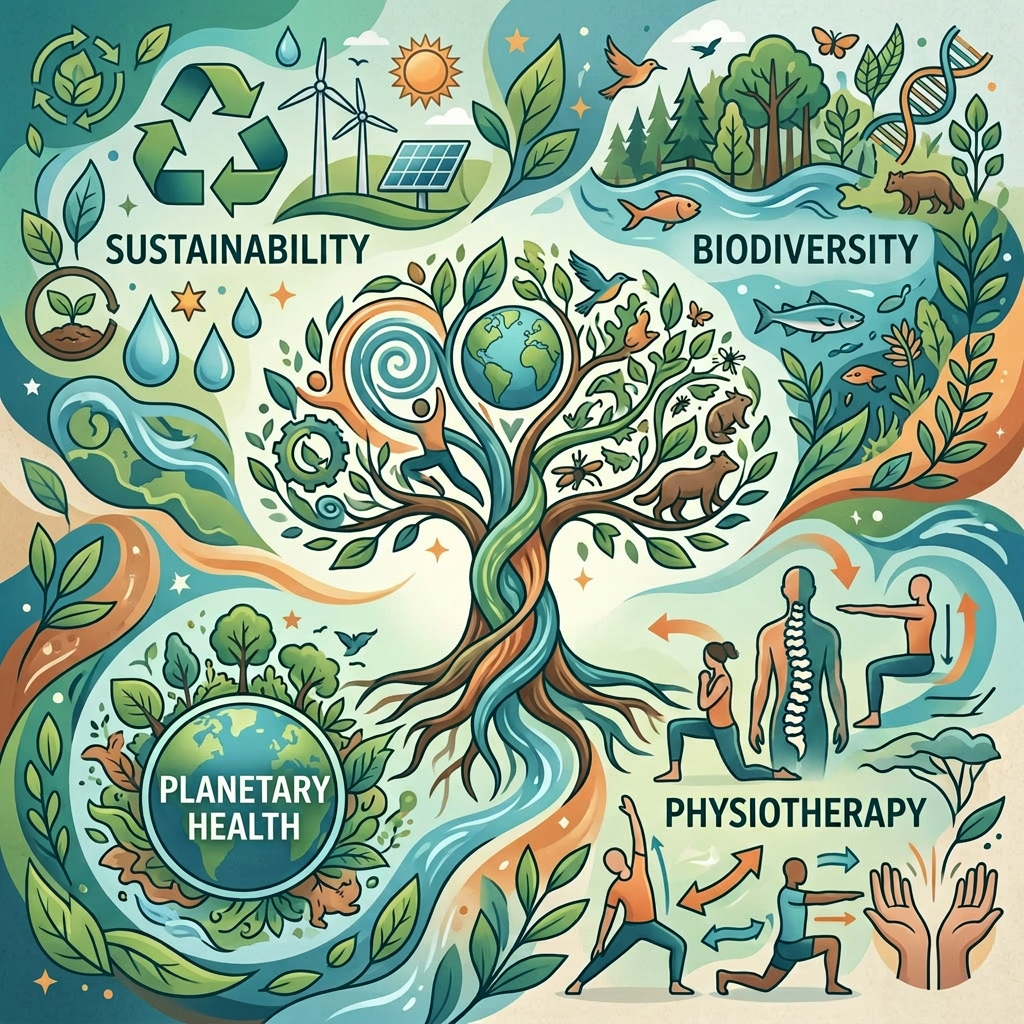
When I first became interested in planetary health and environmental physiotherapy, I found myself asking the same question that I now hear from many colleagues:
“Interesting. But what does that have to do with physiotherapy?”
If I am honest, I was not being dismissive. I was genuinely struggling to see the connection. I am not an urban planner. I am not a politician. I am a physiotherapist. My job is to help people move, recover function, and navigate the challenges that injury, pain, illness, and disability place in their lives. So what can I do about climate change, biodiversity loss, sustainability, or the design of cities as a physiotherapist?
Looking back, I think the question revealed something about how I understood my role as a clinician.
For much of my professional life, I have approached problems with the mindset that many healthcare professionals are taught to develop. We identify a problem, analyse it, formulate a plan, implement an intervention, and evaluate the outcome. Whether consciously or not, I often expected knowledge to provide solutions. If I learned something, I wanted to know what to do with it. If I identified a problem, I wanted a way to fix it.
Planetary health offered no such comfort.
The more I learned, the more I could see the connections. Environmental change affects health. Heatwaves increase risks for vulnerable populations. Air pollution worsens respiratory and cardiovascular disease. The design of our neighbourhoods influences physical activity. Access to green spaces affects both physical and mental wellbeing. Extreme weather events disrupt healthcare access and disproportionately affect those who are already vulnerable (Romanello et al., 2025; World Health Organization, 2023).
Yet I kept returning to the same question:
“Okay, but what am I supposed to do about it?”
The more I reflected on that question, the more I realised it was not only about planetary health. It was about my discomfort with problems that could not be solved through the tools I had available. In many ways, I have encountered this discomfort before. When I first learned about psychology-informed practice, I remember thinking: “I’m not a psychologist.” When discussions turned toward social determinants of health, my reaction was often: “I’m not a social worker.” These ideas made intuitive sense, but they felt distant from the practical realities of being a physiotherapist. I could see their relevance, yet I struggled to understand what role they were supposed to play in my everyday clinical practice.
Physiotherapy itself has undergone a similar evolution. Historically, the profession has tended to locate both problems and solutions within the body. Our expertise centred on tissues, impairments, biomechanics, and physical dysfunction. As Nicholls (2017) has argued, this focus became deeply embedded in how physiotherapy came to understand itself as a profession. Over time, however, broader perspectives emerged. The biopsychosocial model challenged healthcare professions to consider beliefs, emotions, relationships, and social context alongside biological factors (Engel, 1977). The social determinants of health further highlighted the influence of income, education, housing, employment, and social conditions on health outcomes (Marmot, 2005; World Health Organization, 2008).
Yet recognising these influences has not always translated into knowing what to do with them.
The work of Karime Mescouto resonates strongly with me here. Their research suggests that clinicians often embrace broader understandings of health in theory while struggling to integrate them into practice (Mescouto et al., 2020). Reflecting on my own journey, I do not think this struggle stems from ignorance or lack of compassion. Rather, I wonder whether it reflects something deeper about how many of us have been trained to think.
We are fixers.
We are comfortable with assessment, diagnosis, treatment plans, and measurable outcomes. We feel useful when we can intervene. We feel competent when we can offer solutions. Faced with a problem, our instinct is often to ask: “What can I do?” But some of the factors that shape health do not lend themselves to neat interventions. There is no exercise programme for poverty. No manual therapy technique for insecure housing. No strengthening protocol for social isolation. No rehabilitation plan capable of reversing climate change. Faced with realities such as these, I think I have often been tempted to dismiss them—not because they are unimportant, but because they sit beyond my ability to directly influence them.
If I cannot fix it, is it really my business?
The question sounds reasonable. Yet the more I sit with it, the less satisfied I am by the answer. After all, many aspects of healthcare involve understanding things that we cannot control. We do not control the natural history of a condition. We do not control how people respond to treatment. We do not control their workplaces, their finances, their relationships, or the countless events that shape their lives outside the clinic. And yet understanding these factors still matters. It changes how we communicate. It shapes expectations. It influences goal setting. It helps us make sense of why recovery may not unfold as neatly as our textbooks suggest. We may not remove the barrier, but we better understand the terrain through which the person is travelling. This is where I think my understanding of social determinants of health has also evolved. If I am honest, there was a time when “considering social determinants” often meant recognising that someone faced additional challenges and therefore might have a poorer prognosis. A patient was financially stressed, working multiple jobs, caring for family members, or living in difficult circumstances. I acknowledged these realities, perhaps adjusted my expectations slightly, and moved on. But increasingly, I wonder whether this risks reducing social determinants to little more than prognostic factors. We recognise them, yet we remain oddly detached from them. We know they matter, but we struggle to incorporate them into our understanding of care in any meaningful way.


Perhaps planetary health presents a similar challenge.
The irony is that my own circumstances have helped me appreciate this more than any academic paper. When people talk about sustainable physiotherapy, I sometimes catch myself imagining idealised scenarios. A clinic beside a park. Patients arriving on foot or by bicycle. Solar panels on the roof. Exercise sessions outdoors beneath trees. Native birds singing in the background. The reality of my daily practice looks rather different.
I currently work in a low socioeconomic area. The clinic sits within a landscape dominated by roads, car parks, supermarkets, and fast-foods. Many of my patients face financial stress, chronic health conditions, physically demanding work, and complex social circumstances. The clinic sits next to a child protection service, a reminder of a painful chapter of Australia’s history (the stolen generation) and ongoing injustices that continue to shape the lives of many Aboriginal families and communities today.
When I think about encouraging active transport, I am forced to confront the reality that many of my patients live in environments that were never designed for it. If someone goes for a walk, they may find themselves alongside busy roads passed by massive road-trains. Pedestrian infrastructure is limited. Cycling infrastructure is sub-optimal. The conditions that make healthy choices easier simply do not exist in the way they do in the sustainability thought experiments we often encounter.If I am honest, I am not standing outside these realities looking in.
As a migrant physiotherapist dependent on visa sponsorship, I am constrained too. I cannot decide where my workplace is located. I cannot redesign the neighbourhood. I cannot transform the local economy or reshape urban planning decisions made decades ago. Like many of my patients, I am navigating systems that exert considerable influence over my choices.
Perhaps this is another lesson planetary health has taught me. The same systems that shape the health of my patients also shape my ability to practise. Suddenly, sustainability stops being a discussion about individual choices. It becomes a discussion about context, power, opportunity, and constraint. It becomes a discussion about the environments that shape all of us. This, I think, is where the distinction between understanding and responsibility becomes important.I can understand that poverty affects health without being responsible for eliminating poverty. I can understand that urban design influences physical activity without becoming an urban planner. Likewise, I can understand that climate change affects health without being responsible for solving climate change.
Understanding does not automatically create responsibility. But neither does the absence of responsibility make understanding irrelevant. The concept of planetary health captures this idea well. At its heart is the recognition that human health depends upon the health of the natural systems that sustain life (Whitmee et al., 2015). From this perspective, environmental issues are not separate from health concerns. They are part of the context within which health, illness, recovery, and rehabilitation occur. Increasingly, I suspect that this is what draws me to these conversations. Not because I believe physiotherapists should become environmental activists. Not because I think we must solve climate change before our next patient arrives. But because these discussions force me to confront a deeper question about professional practice.
Do I only value knowledge when it gives me something to fix?
The more I reflect on it, the more I think maturity as a clinician may involve learning to sit with problems that exceed our capacity to solve them. To acknowledge the forces that shape health even when they lie beyond our control. To recognise the constraints affecting our patients, our communities, and ourselves. Like the weather on a long trek, environmental conditions may not be things we can control. But they remain part of the landscape through which every journey unfolds. Understanding that landscape does not guarantee a better outcome. It does not make us responsible for changing it. Yet it may help us better understand the world in which health, illness, and rehabilitation take place.
And perhaps that, in itself, is reason enough to care.
References
Engel, G. L. (1977). The need for a new medical model: A challenge for biomedicine. Science, 196(4286), 129–136. https://doi.org/10.1126/science.847460
Marmot, M. (2005). Social determinants of health inequalities. The Lancet, 365(9464), 1099–1104. https://doi.org/10.1016/S0140-6736(05)71146-6
Mescouto, K., Olson, R. E., Hodges, P. W., & Setchell, J. (2020). A critical review of the biopsychosocial model of low back pain care: time for a new approach? Disability and Rehabilitation, 44(13), 3270–3284. https://doi.org/10.1080/09638288.2020.1851783
Nicholls, D. (2017). The End of Physiotherapy. Routledge
Romanello, M., et al. (2025). The Lancet Countdown on health and climate change 2025 report. The Lancet.
Whitmee, S., Haines, A., Beyrer, C., Boltz, F., Capon, A. G., Dias, B. F. S., Ezeh, A., Frumkin, H., Gong, P., Head, P., Horton, R., Mace, G. M., Marten, R., Myers, S. S., Nishtar, S., Osofsky, S. A., Pattanayak, S. K., Pongsiri, M. J., Romanelli, C., … Yach, D. (2015). Safeguarding human health in the Anthropocene epoch: Report of The Rockefeller Foundation–Lancet Commission on Planetary Health. The Lancet, 386(10007), 1973–2028. https://doi.org/10.1016/S0140-6736(15)60901-1
World Health Organization. (2008). Closing the gap in a generation: Health equity through action on the social determinants of health. WHO.
World Health Organization. (2023). Climate change and health. https://www.who.int/news-room/fact-sheets/detail/climate-change-and-health