

One of the most common questions I hear in clinic is surprisingly simple: “How do I know if I’m doing too much?” Closely followed by another: “How do I know if I’m doing enough?”
Whether someone is recovering from an Achilles tendinopathy, shoulder pain, a fracture, surgery, persistent back pain, or simply trying to regain fitness after a period of inactivity, these questions sit at the heart of rehabilitation. Patients often expect recovery to depend on finding the perfect exercise, the perfect stretch, or the perfect treatment. In reality, successful rehabilitation is often much less about finding the perfect exercise and much more about finding the right amount of challenge.
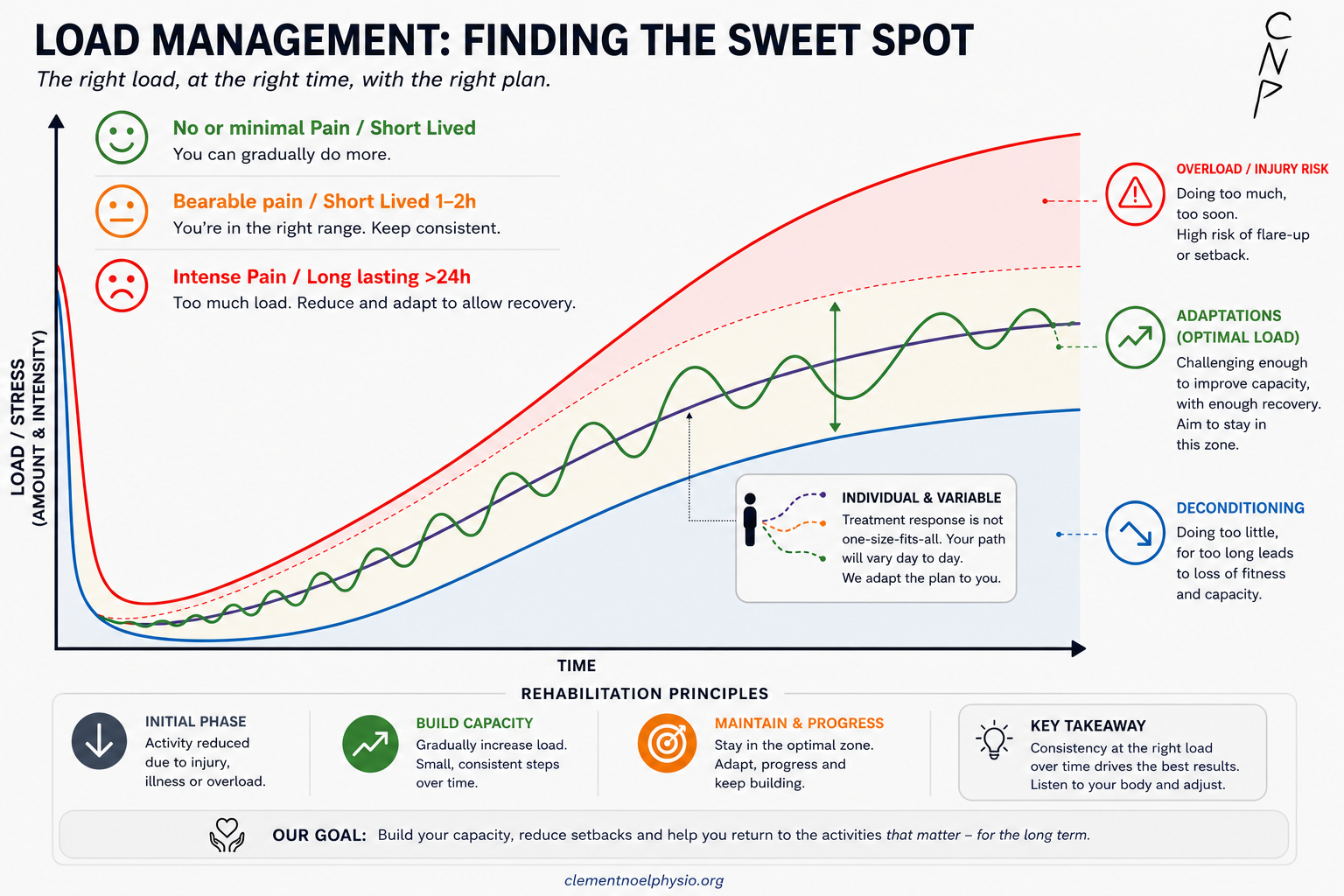
The infographic above is my attempt to capture that idea visually. This article expands on the concepts behind it and explores why load management sits at the centre of so much of what we do in physiotherapy.
At its core, rehabilitation is often a balancing act. Too little challenge can lead to deconditioning and loss of capacity. Too much challenge can lead to symptom flare-ups, setbacks, and frustration. Somewhere between these two extremes lies a zone where the body can adapt, recover, and become more resilient over time.


The body adapts to what we ask of it
One of the most remarkable features of the human body is its ability to adapt. Muscles become stronger when challenged. Bones become denser when exposed to appropriate loading. Tendons remodel in response to repeated forces. The cardiovascular system becomes more efficient when exercised regularly. Even the nervous system changes in response to movement, practice, and experience.
This process is often described through the concept of mechanotransduction: the conversion of mechanical forces into biological responses within tissues. Khan and Scott’s influential paper on mechanotherapy highlighted how physical loading acts as a stimulus that encourages tissues to repair, reorganise, and strengthen themselves. In simple terms, our tissues are not passive structures waiting to be fixed. They are living systems constantly responding to the demands placed upon them.
The body is therefore always listening to the messages we send through movement and activity. Every walk, every lift, every run, and every exercise session provides information. The question is not whether load influences recovery. The question is whether the message we are sending is appropriate for the current capacity of the individual.
Too little load has consequences
When people are injured, reducing activity is often necessary. Pain, swelling, surgery, fractures, illness, or acute inflammation may require a temporary decrease in movement while the body begins the recovery process. Rest can be useful, particularly in the early stages of some conditions.
Problems arise when this reduction in activity continues for too long. Muscles begin to lose strength, tendons lose capacity, cardiovascular fitness declines, and confidence often drops alongside physical function. The body adapts to inactivity just as readily as it adapts to exercise.
This is one reason why modern rehabilitation has moved away from prolonged periods of complete rest for many musculoskeletal conditions. While there are exceptions, most rehabilitation programmes aim to maintain some degree of safe movement and activity throughout recovery. The goal is rarely to avoid all loading. Instead, it is to identify the amount of loading that supports recovery rather than hinders it.
In the infographic, this is represented by the lower blue zone: the deconditioning zone. It is not necessarily harmful in the short term, but spending prolonged periods there means the body gradually loses capacity. Eventually, activities that were once easy may become difficult simply because the system has become less prepared to tolerate them.
Too much load also has consequences
At the opposite end of the spectrum sits overload. Most people have experienced this at some point in their lives. Perhaps it was returning to running after several months off and attempting the same distance as before. Perhaps it was spending an entire weekend gardening after a sedentary few weeks. Or perhaps it was heading back to the gym and trying to lift the same weights used before an injury.
The result is often a significant increase in symptoms. Sometimes this reflects irritation of healing tissues. Sometimes it reflects a temporary increase in sensitivity within the nervous system. Often, it is a combination of several factors. Regardless of the precise mechanism, the outcome is usually the same: the challenge exceeded what the system was currently prepared to tolerate.
In the infographic, this is represented by the upper red zone. Entering this zone occasionally does not automatically mean damage has occurred. Human bodies are robust and adaptable. However, large increases in symptoms that are intense, prolonged, and take several days to settle often suggest that the balance between load and capacity has temporarily been lost.
The sweet spot sits in between
Between underloading and overloading lies the zone where adaptation occurs. This is where rehabilitation becomes both interesting and challenging. The goal is not to avoid all discomfort, nor is it to push through any amount of pain. Instead, the aim is to apply enough challenge to stimulate adaptation while allowing sufficient recovery for those adaptations to occur.
This is the space where most successful rehabilitation programmes live. Activities are challenging enough to encourage change but not so demanding that recovery is constantly disrupted. Over time, this balance allows capacity to gradually increase.
The green line in the infographic represents what many people experience during this process. Progress is rarely smooth. Capacity rises and falls. Symptoms fluctuate. Some days feel encouraging while others feel disappointing. Yet despite these short-term variations, a broader trend often emerges.
The purple line represents that longer-term trajectory. While the day-to-day experience may feel messy and unpredictable, meaningful progress often becomes visible when viewed over weeks and months rather than hours and days.
Why pain is an imperfect guide
If load management were simply a matter of avoiding pain, rehabilitation would be much easier. Unfortunately, pain is more complex than that.
Pain is influenced by tissue health, but it is also shaped by sleep, stress, previous experiences, emotions, expectations, fatigue, general health, and countless other factors. As a result, pain does not provide a direct readout of tissue damage.
A painful response to exercise does not necessarily mean that harm has occurred. Equally, an absence of pain does not always mean that a tissue is fully prepared for a particular demand. This complexity is one reason why clinicians use symptom responses as one piece of information rather than the sole determinant of progression.
The traffic-light system shown in the infographic provides a practical framework rather than a rigid rule. Minimal or short-lived symptoms often suggest that progression may be appropriate. Bearable symptoms that settle relatively quickly may indicate that the current level of loading is about right. Intense symptoms that remain elevated for more than a day often suggest that some modification or temporary reduction may be helpful.
Like all frameworks, this approach has limitations. Different conditions respond differently to loading. Individual circumstances matter. Nevertheless, it provides a useful starting point for many rehabilitation programmes and helps people develop confidence in monitoring their own responses.
Progress is rarely linear
One of the biggest misconceptions about recovery is the belief that improvement should occur in a straight line. Many patients become concerned when symptoms increase slightly after a period of progress. They often assume something has gone wrong or that they have undone weeks of hard work.
In reality, biological adaptation is rarely linear. Training studies, sports performance research, and rehabilitation literature consistently demonstrate considerable variability in human responses to loading. Recovery occurs within the context of a complex system influenced by physiology, psychology, lifestyle, environment, and chance.
The presence of occasional setbacks does not automatically indicate failure. In many cases, temporary flare-ups are simply part of the process of exploring where current limits lie and gradually expanding them. Learning to distinguish between expected fluctuations and meaningful overload is an important part of rehabilitation.
This is where clinical reasoning, ongoing monitoring, and regular reassessment become valuable. Rather than reacting to every fluctuation, we can focus on broader patterns and trends over time.
Rehabilitation is an ongoing conversation
One of the reasons I enjoy physiotherapy is that rehabilitation is rarely about delivering a fixed recipe. There is no universal programme that works perfectly for every person in every situation.
Instead, rehabilitation is often an ongoing process of observation, experimentation, adaptation, and learning. We try something. We observe the response. We adjust accordingly. New information emerges, and the plan evolves alongside it.
The process often feels less like construction and more like navigation. We are not following a perfectly accurate blueprint from the outset. Rather, we are continuously updating our map as we gather more information about the terrain ahead.
This means that rehabilitation plans should change over time. An exercise programme that was appropriate four weeks ago may now be too easy. A programme that felt manageable last week may need adjustment following a flare-up, illness, poor sleep, increased stress, or changing life demands.
The goal is therefore not rigid adherence to a plan. The goal is responsiveness. Good rehabilitation adapts to the person rather than forcing the person to adapt to the plan.
The long-term goal
When people think about rehabilitation, they often focus on reducing pain. Pain reduction is important, particularly when symptoms are limiting daily life. However, rehabilitation is ultimately about something much larger.
It is about rebuilding capacity. The ability to walk further, lift more, run longer, work comfortably, play sport, garden, travel, play with children, or participate in the activities that make life meaningful. These outcomes matter because they restore options, independence, and confidence.
Capacity is what allows us to engage with life on our own terms. It is built gradually through appropriately dosed exposure to challenge over time. Not through complete avoidance. Not through relentless pushing. But through repeatedly finding that sweet spot where adaptation can occur.
The challenge, of course, is that this sweet spot is rarely fixed. It shifts as recovery progresses, as life circumstances change, and as our capacity evolves. Learning to recognise it, monitor it, and adjust around it is one of the most valuable skills rehabilitation can teach.
And perhaps that is the central message behind load management: recovery is rarely about doing as much as possible, nor as little as possible. It is about doing enough to encourage adaptation while allowing the body the opportunity to respond. Finding that balance is not always easy, but it is often where the most meaningful progress occurs.
References
Khan KM, Scott A. Mechanotherapy: How physical therapists’ prescription of exercise promotes tissue repair. British Journal of Sports Medicine. 2009;43(4):247–252.
Booth FW, Roberts CK, Laye MJ. Lack of exercise is a major cause of chronic diseases. Comprehensive Physiology. 2012;2(2):1143–1211.
Bohm S, Mersmann F, Arampatzis A. Human tendon adaptation in response to mechanical loading. Nature Reviews Rheumatology. 2015;11(12):655–665.
O’Sullivan P, Caneiro JP, O’Keeffe M, et al. Cognitive Functional Therapy: An integrated behavioural approach for the targeted management of disabling low back pain. Physical Therapy. 2018;98(5):408–423.
ENGLISH 🇬🇧🇦🇺🇳🇿🇺🇸 …
Also Available in other languages! (If you would like your language to be available, please send me an email)
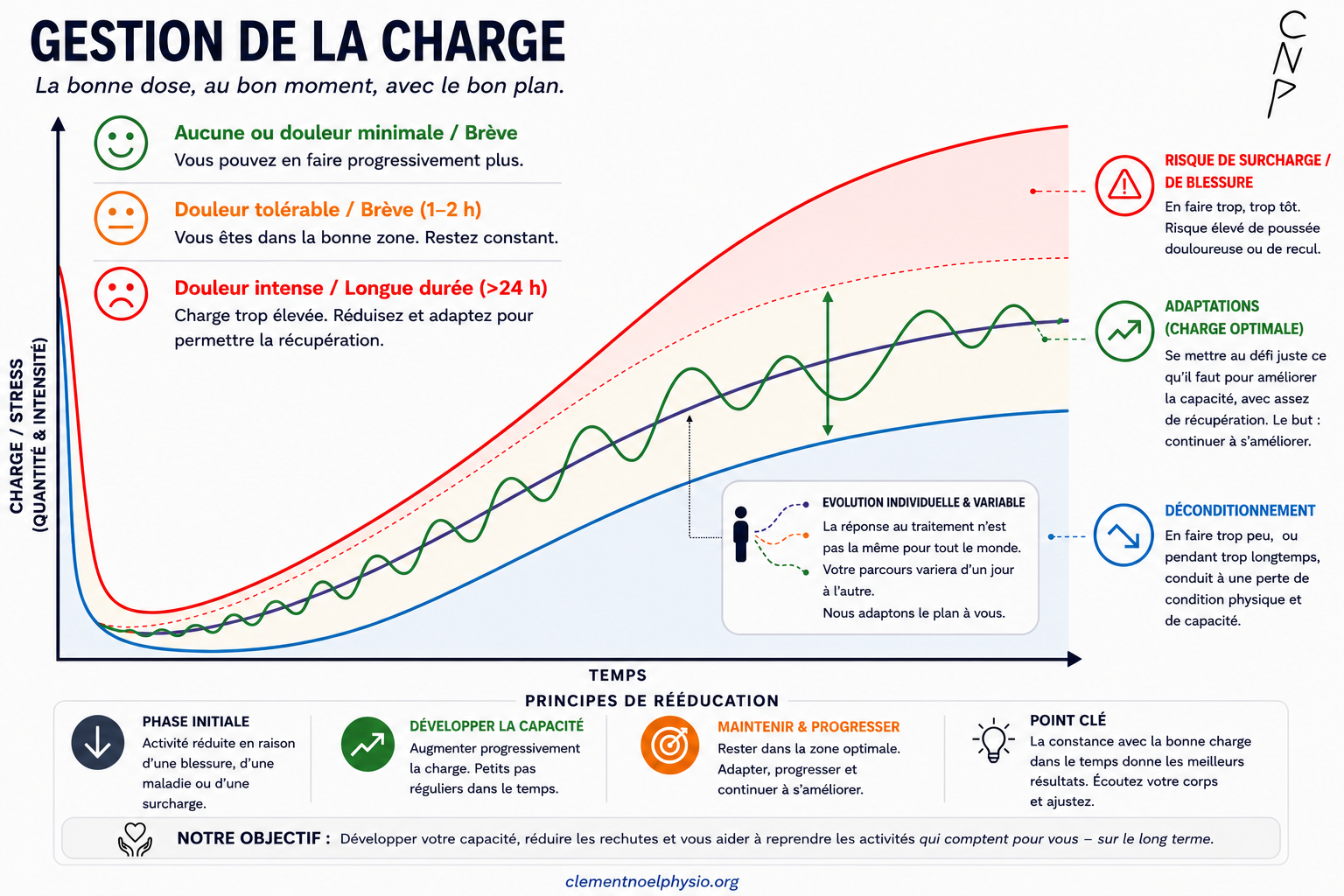
FRENCH 🇫🇷
DUTCH 🇳🇱
