


There are some papers that shape how you think and practice. For me, Back to Basics: 10 Facts Every Person Should Know About Back Pain by O’Sullivan and colleagues is one of them. Published in the British Journal of Sports Medicine in 2019, it distilled a large body of evidence into ten simple messages aimed at challenging common misconceptions about back pain.
I’ve recommended the paper countless times over the years. I love its central message: many of the things we commonly believe about back pain are not supported by evidence, and those beliefs can sometimes make recovery harder rather than easier. The authors argue that unhelpful beliefs can drive fear, avoidance, excessive protection, unnecessary healthcare seeking, and poorer outcomes. Ironically, despite loving the content, I rarely used the original infographic in the clinic because I often found it difficult to use with patients. It tried to communicate ten important ideas at once. The information was dense, the text was small, and I felt that many patients would struggle to quickly identify the key messages most relevant to them. So, after years of thinking, “I wish there was a version that worked better for my clinical practice,” I finally decided to make one.
Rather than redesigning the original infographic, I reorganised the ten facts into three broader themes that mirror the conversations I often have with patients.

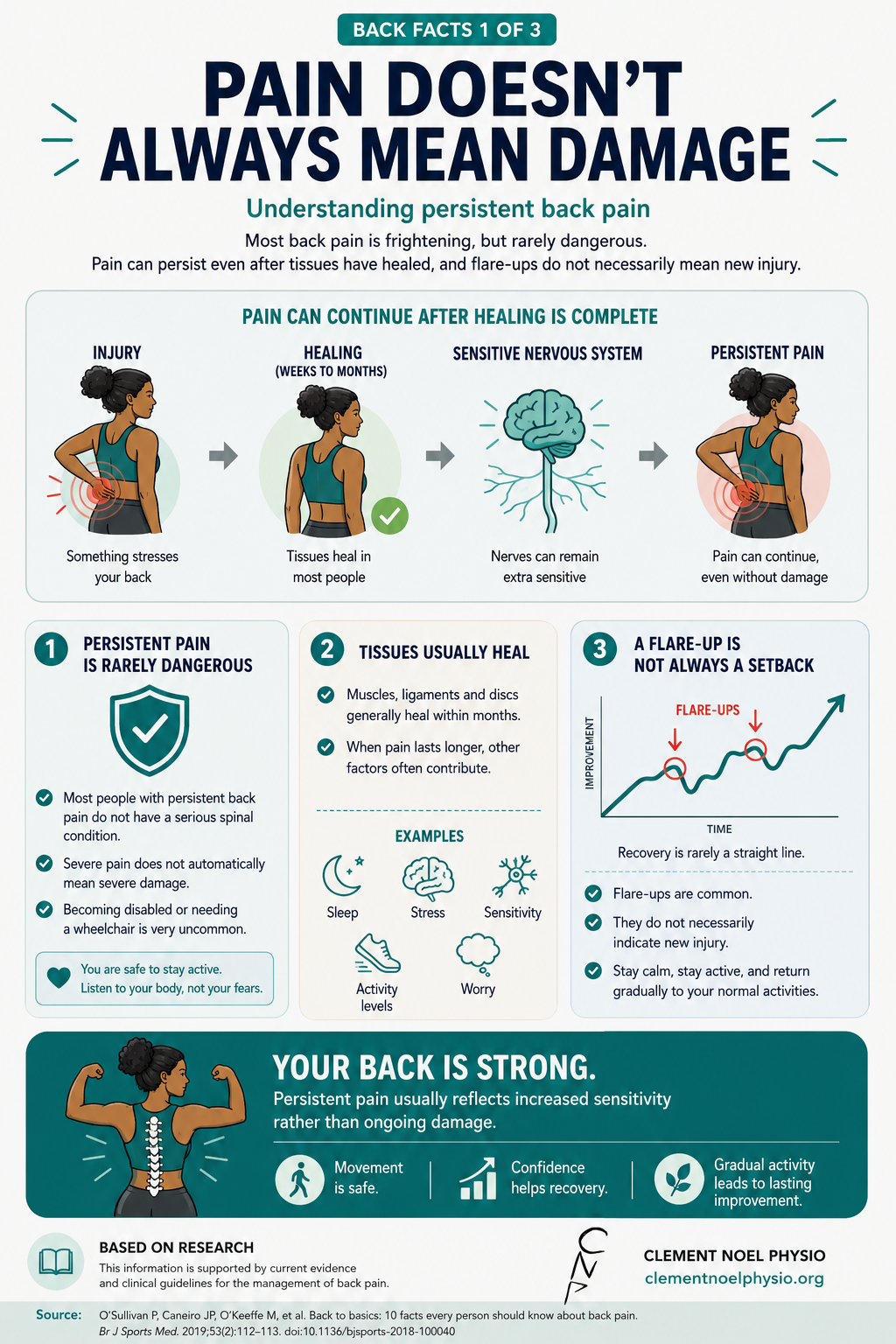
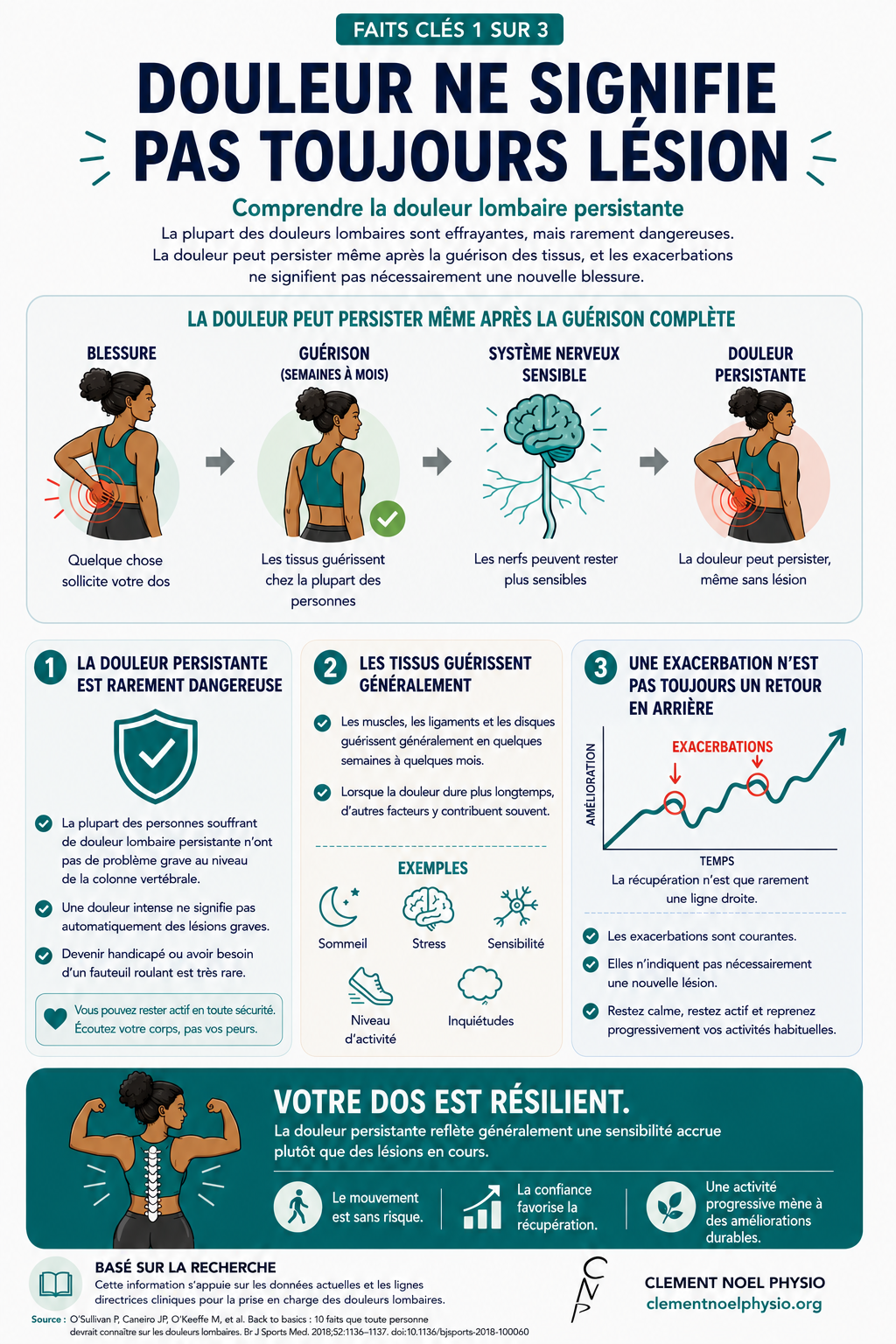
1. Pain Doesn’t Always Mean Damage
Many people understandably worry that ongoing pain means ongoing injury. The evidence suggests otherwise. The paper highlights that persistent back pain is rarely associated with serious tissue damage, that pain can persist after tissues have healed, and that flare-ups do not necessarily mean new harm has occurred. This first infographic focuses on helping people understand that pain and damage are not always the same thing.
2. Your Back Is Strong
A surprising amount of fear surrounding back pain comes from beliefs that our backs are fragile. The paper challenges several common myths: that ageing inevitably causes back pain, that poor posture is the cause of pain, that people need a strong “core” to protect themselves, or that everyday bending and lifting gradually wear the spine out. Instead, the evidence points towards a more reassuring message: backs are adaptable, resilient structures designed for movement and loading.
3. Recovery and Treatment: What Helps and What Doesn’t
The final infographic focuses on recovery. It explores the limitations of scans, the importance of movement, and why injections, surgery and strong medications are often not the solution many people hope they will be. The paper emphasises that effective care is often surprisingly simple: good education, physical activity, healthy lifestyle habits, confidence, and support to remain engaged in meaningful life activities. Not necessarily easy—but often simpler than we are led to believe.

Summary
If I had to summarise the paper in a few sentences, it would be this:
Most back pain is not dangerous. Backs are stronger and more adaptable than many people realise. Pain is influenced by many factors beyond tissue injury alone, and movement is generally safe and helpful. Scans often tell us less than we think, while recovery is usually built through understanding, confidence, gradual activity and self-management rather than through finding a single “fix.”
These messages may seem simple, but they matter. The authors point out that beliefs about back pain are associated with levels of pain, disability, healthcare use and recovery outcomes. Helping people understand back pain differently may therefore be an important part of helping them recover differently.

Open Access
As usual, I’ve made all three infographics freely available to download, share and use.
If you’re a patient, I hope they provide some reassurance and clarity.
If you’re a clinician, feel free to use them in your practice if you think they might help facilitate conversations with the people you work with. If you choose to share or reuse them, I’d appreciate keeping the logo and source information attached so both the original paper and my adaptation remain acknowledged.
The ideas belong to the paper’s authors and the wider body of research. I’ve simply tried to package them in a format that better suits the way I communicate in the clinic.
Reference
O’Sullivan PB, Caneiro JP, O’Sullivan K, Lin I, Bunzli S, Wernli K, O’Keeffe M. Back to basics: 10 facts every person should know about back pain. British Journal of Sports Medicine. 2019. doi:10.1136/bjsports-2019-101611.
ENGLISH 🇬🇧🇦🇺🇳🇿🇺🇸 …


Also Available in other languages! (If you would like your language to be available, please send me an email)
FRENCH 🇫🇷


DUTCH 🇳🇱


Discover more from A physiotherapist's learning journey
Subscribe to get the latest posts sent to your email.
Leave a Reply